



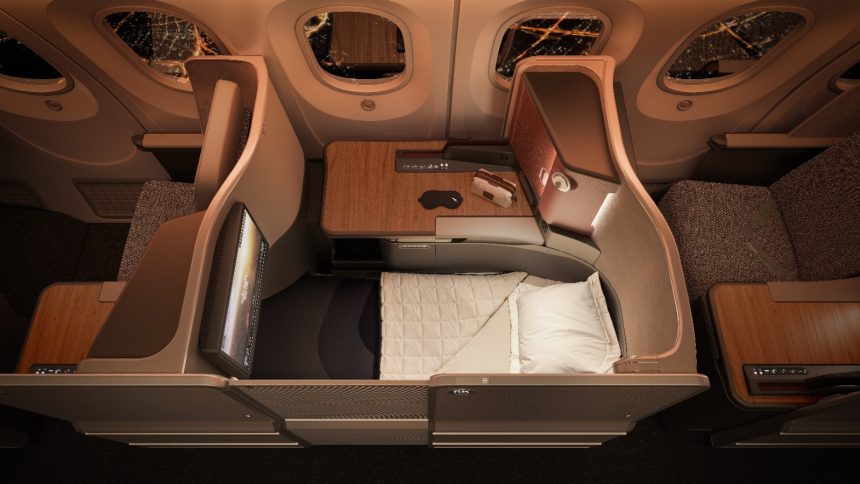
The airline’s new A321XLR Business Suite brings lie-flat comfort, privacy doors and a premium long-haul proposition to single-aisle flying. At the same time, an evolved 787-9 Business Suite raises the privacy bar across its widebody fleet.
Qantas is taking a significant step in redefining its premium cabin proposition, unveiling a new Business Suite for its Airbus A321XLR fleet that will introduce lie-flat beds to a Qantas single-aisle aircraft for the first time.
The new cabin product is part of the airline’s largest fleet renewal programme and reflects a broader shift in how airlines are approaching premium cabin design as demand for higher-value travel continues to grow.
For Qantas, that means bringing elements traditionally associated with widebody long-haul cabins, including a fully flat bed, individual privacy and enhanced connectivity—into a narrowbody environment.
The first of 16 A321XLRs configured with the new Business Suites is scheduled to arrive in 2028. With a range of up to 8,700km, the aircraft will give Qantas greater flexibility to deploy a premium product on longer domestic services, including transcontinental routes to and from Perth, as well as short- and medium-haul international routes. Qantas says its A321XLR fleet will include lie-flat Business seats on 16 aircraft.
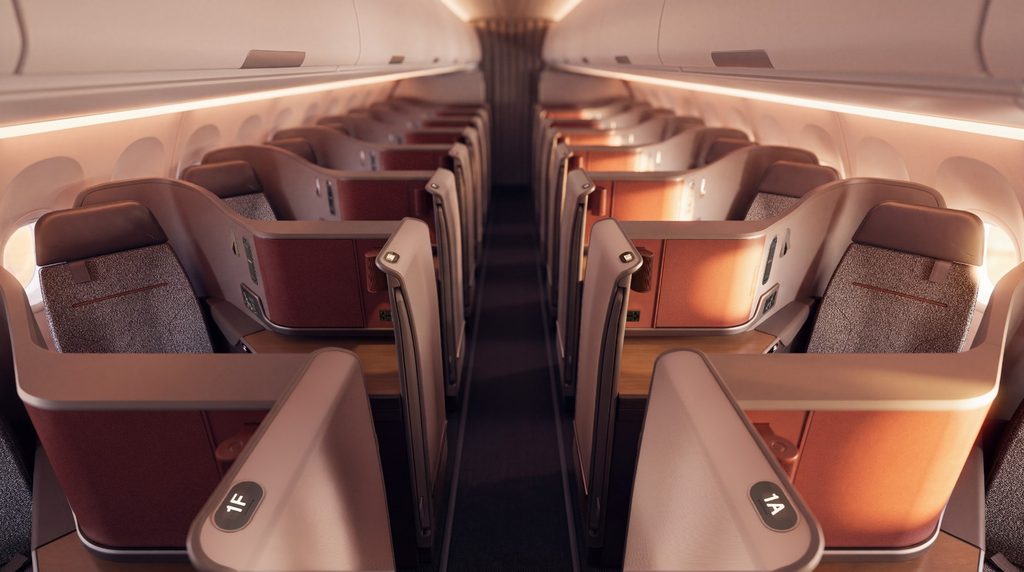
A Narrowbody designed around privacy
At the heart of the new A321XLR interior is a 1-1 angled herringbone Business Class configuration. The layout makes efficient use of the single-aisle cabin while giving every Business passenger a lie-flat bed and direct aisle access. More importantly, each passenger will have a sliding privacy door, creating an individual space that can transition between working, dining and sleeping.
For Qantas, this represents a substantial departure from the traditional premium proposition on its single-aisle aircraft. Rather than simply offering a larger recliner, the airline is effectively creating a compact suite environment within the constraints of a narrowbody fuselage.
The design reflects a broader industry movement towards privacy as a defining component of premium travel. Sliding doors have increasingly become a feature of high-end Business Class cabins, although their integration brings additional certification and evacuation considerations for airlines and seat manufacturers. The result is a cabin concept designed to make a passenger feel less like they are travelling in a conventional narrowbody Business Class seat and more like they have their own personal space.
Bringing long-haul experience to a single-aisle
The A321XLR has become an important platform for airlines seeking to open longer routes where the passenger demand may not justify a widebody aircraft. Its range of up to 8,700km gives Qantas the ability to connect destinations that previously required larger aircraft or could not be economically served with a single-aisle platform. That capability changes the cabin equation.
As narrowbody aircraft increasingly operate longer sectors, passenger expectations also rise. A seat designed primarily for a short domestic flight becomes less suitable when the same aircraft is used for overnight or multi-hour international services. Qantas’ response is to create a premium cabin that can support the complete journey.
The Business Suite includes a 19-inch entertainment screen, wireless charging, USB-C connectivity and fast, free Wi-Fi. Generous storage is designed to keep laptops and personal belongings accessible without compromising the passenger’s sleeping or working space.
The combination suggests that Qantas is treating the A321XLR not simply as a smaller aircraft, but as a platform capable of delivering a premium experience tailored to longer missions.
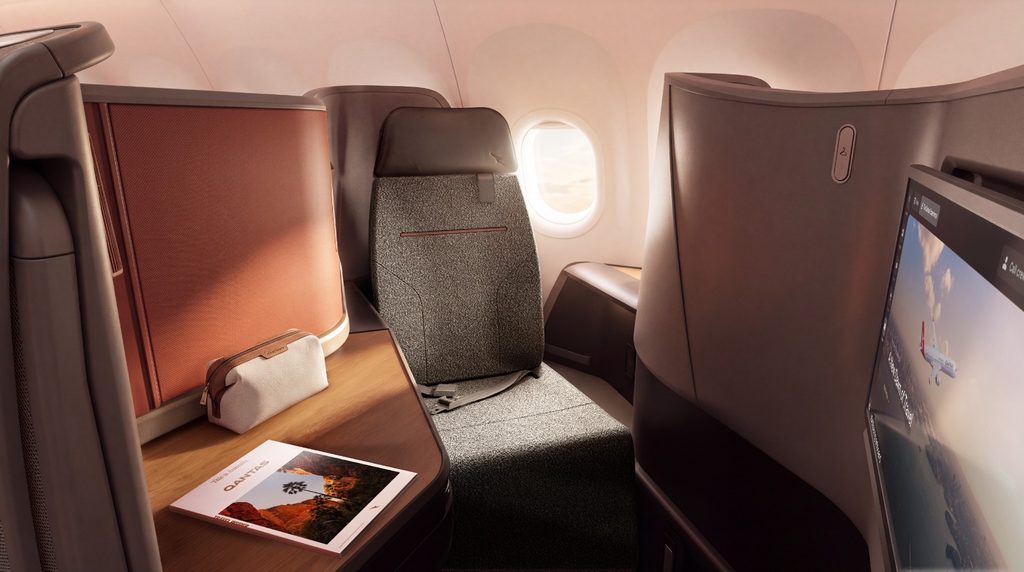
Premium demand drives the design
The investment is also closely linked to changing passenger economics. Qantas says premium cabin revenue is growing at twice the rate of Economy across its international network, prompting the airline to increase the proportion of premium seating on its next-generation aircraft. That shift is increasingly visible across the industry.
Airlines are investing in larger Business Class cabins, more private seating configurations, direct aisle access, lie-flat beds and upgraded connectivity as premium passengers demonstrate a willingness to pay for greater comfort and privacy.
For Qantas, the A321XLR provides an opportunity to match that demand with a more flexible aircraft platform. The airline’s strategy effectively separates the aircraft from the traditional idea that narrowbody flying necessarily means a compromise in premium comfort.
New generation of Qantas business class
Qantas has not limited its premium cabin refresh to the A321XLR.
The airline has also revealed an evolved Business Suite for additional Boeing 787-9 Dreamliners on order, bringing several of the design principles from the new narrowbody product into its long-haul fleet.
Each of the new 787-9s will feature 42 Business Suites, with sliding privacy doors being introduced on a Qantas Dreamliner for the first time.
The updated suites will feature new 80-inch lie-flat beds, providing more space for customers to sleep and stretch out during long-haul flights.
The seat itself is an evolution of the existing Qantas Business Suite, but the airline has incorporated a wider footwell following ergonomic trials and customer feedback.
That detail is significant because the sleeping experience in a Business Class suite depends on more than bed length.
Footwell width, sleeping position, seat geometry, storage and ease of movement all contribute to how effectively a seat converts from a daytime workspace into a practical overnight environment. Qantas appears to have approached the redesign with this broader ergonomic equation in mind.
Designing personal space
The 787-9 Business Suite will also receive a redesigned personal storage area and a 19-inch entertainment screen. The interior aesthetic draws inspiration from the Australian landscape, with a rich colour inspired by the red earth of Western Australia’s Pilbara region.
It is a subtle design choice, but one that reflects the increasingly important role of visual identity in premium cabin design. Modern Business Class products are no longer defined solely by seat dimensions. Airlines are increasingly attempting to create a recognisable environment through materials, textures, lighting, colour palettes, personal space and architectural details. The cabin becomes part of the brand.
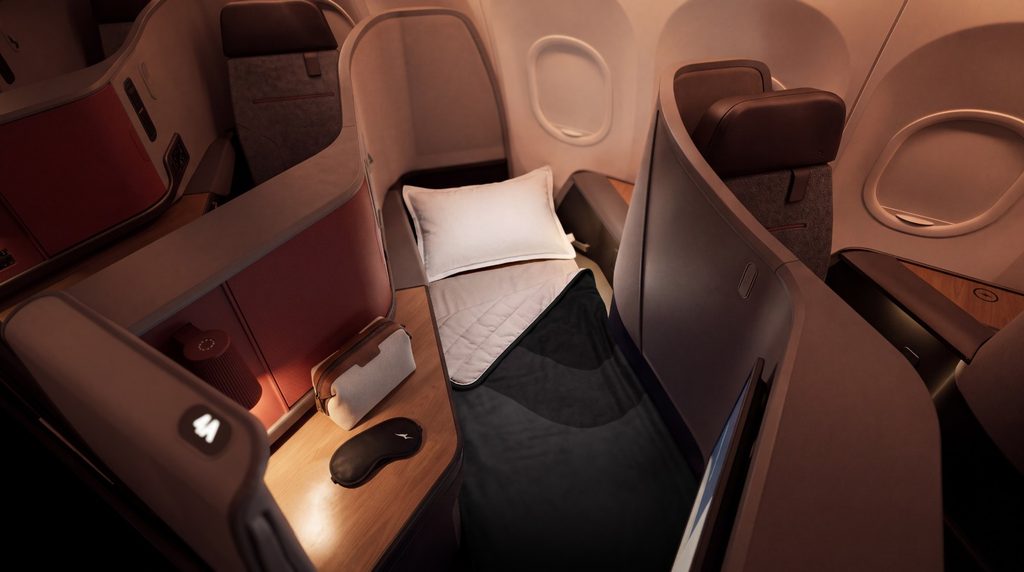
From seat to suite
Perhaps the most important element across both products is the transition from seat-centric design to space-centric design. The A321XLR Business Suite is not simply a lie-flat seat placed into a narrowbody cabin. Its 1-1 configuration, privacy door, storage, connectivity, and screen are designed to create an individual environment.
Likewise, the updated 787-9 product uses the privacy door and wider sleeping area to give passengers greater control over their personal space. That reflects a fundamental shift in premium cabin expectations. Passengers increasingly want the ability to decide when they are interacting with the cabin environment and when they can retreat from it. A privacy door provides that physical boundary.
The certification challenge
For cabin manufacturers and airlines, however, increasingly sophisticated suites also create a more complex certification environment. Privacy doors, movable elements and more enclosed seating configurations must satisfy stringent safety and evacuation requirements.
The recent introduction of several new Business Class products across the industry has highlighted how seat certification can become a critical part of aircraft delivery and entry-into-service timelines. For Qantas, the A321XLR programme therefore represents not only a design exercise but also a significant engineering and certification undertaking.
The challenge is to integrate a sophisticated suite into the constrained dimensions of a single-aisle aircraft without compromising passenger movement, crew operations or regulatory requirements.
The A321XLR a premium platform
Qantas’ strategy also illustrates why the A321XLR is becoming an increasingly important aircraft for premium cabin innovation. The aircraft combines extended range with the economics of a single-aisle platform, allowing airlines to consider routes where widebody capacity may be excessive but passenger demand still supports a differentiated premium offering.
Qantas’ own fleet strategy reflects that flexibility. The airline says its A321XLR will initially replace Boeing 737 aircraft and offers a substantial increase in premium seating capacity compared with the aircraft it replaces.
With lie-flat Business Suites on 16 aircraft, Qantas is effectively creating two distinct premium propositions within its A321XLR fleet: a more conventional recliner-based product for shorter operations and a fully lie-flat suite for longer missions. That flexibility could become increasingly valuable as network planning evolves.
Premium narrowbody flying
The Qantas announcement is part of a much larger transformation taking place inside the narrowbody cabin. The A321XLR is changing where single-aisle aircraft can fly, but premium cabin design is changing what passengers expect when they get there. As range increases, airlines have to think differently about sleep, privacy, storage, connectivity and personal space. Qantas’ answer is clear: if a narrowbody aircraft is going to operate long enough sectors to compete with widebody missions, its premium cabin needs to deliver a comparable level of comfort.
The A321XLR Business Suite brings that philosophy to Qantas’ single-aisle fleet through a combination of lie-flat seating, a 1-1 configuration, privacy doors and a suite of digital and personal-space features. The updated 787-9 product takes the same philosophy into the long-haul cabin, adding privacy and ergonomic refinements to an established Business Class proposition.
Together, the two products point towards a premium cabin strategy increasingly centred on privacy, personal space and sleep quality rather than simply seat size.
For Aircraft Interiors Today, that makes the Qantas programme particularly noteworthy. It is not just another new Business Class seat.
It is an example of how aircraft interiors are evolving alongside the aircraft themselves and how the boundaries between narrowbody and widebody premium experiences are becoming increasingly blurred.