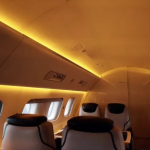



As Air India undergoes one of the most ambitious transformation programmes in global aviation, customer experience has emerged as a central pillar of its reinvention strategy. Backed by the Tata Group’s Vihaan.AI transformation roadmap, the airline is investing heavily across fleet modernization, digital technologies, airport processes, onboard products and service delivery to redefine what passengers can expect from India’s flag carrier.
At the forefront of this journey is Rajesh Dogra, Chief Customer Experience Officer, who brings extensive experience in leading large-scale transformation programmes, including the successful modernization of India’s Passport Seva initiative. Under his leadership, Air India has adopted a customer-first approach that combines data-driven decision-making, digital innovation and operational accountability to improve every stage of the passenger journey, from booking and check-in to inflight experience and post-flight support.
In this exclusive conversation with Aircraft Interiors Today, Dogra discusses how Air India is leveraging technology, customer feedback and organizational transformation to build a world-class passenger experience. He shares insights into the airline’s fleet retrofit programme, AI-driven customer engagement initiatives, premium hospitality offerings, and the lessons learned from managing complex transformation projects at scale. He also outlines how Air India aims to differentiate itself in an increasingly competitive market while building trust, consistency and service excellence across its rapidly expanding network.
Q. You’ve led large-scale transformation programs across sectors. How has that experience shaped your approach to customer experience at Air India during this phase of transformation?
A. Having led a large-scale transformation before, one of my biggest lessons has been that technology is only an enabler – the true compass is always the customer. The greatest learning for me has been to start with the problem, not the solution. At Air India, we are on a similar journey: taking a legacy institution and reimagining it under the Tata Group.
From my previous experience, a core insight was Powering Experience through Seamless Governance. Passport Seva succeeded because every step of the application process became trackable, transparent, and accountable. We have brought that same discipline to Air India – moving away from sporadic, paper-based feedback to a centralized digital listening platform.
We asked ourselves a fundamental question: Where is the passenger experiencing pain, and what is the fastest, most meaningful way to remove it? Simple as it sounds, keeping this question at the center of every decision in a complex transformation – spanning fleet, network, technology, and culture – is far from easy. Yet we have embedded this discipline into our operating model, ensuring every choice is anchored in identifying pain points early and resolving them quickly at scale.
For example, we mapped 28 touchpoints across a customer’s journey – from booking to deplaning – to uncover gaps and determine the best ways to address them. This structured approach ensures that transformation is not abstract, but directly tied to improving passenger experience
Q. What does “world-class passenger experience” mean in the context of Air India today?
A. At Air India, a ‘world-class passenger experience’ is not simply a catchphrase; it is a measurable, structural promise. It means delivering a seamless, reliable, and pleasant journey. Today, under Vihaan.AI, we are entirely redefining what it means to fly with India’s national carrier. We look at this transformation across five core pillars:

a) A Modernised, Consistent Cabin Product – We are investing 400 million dollars into a massive fleet retrofit programme to ensure our passengers experience next-generation comfort.

b) Reimagining Inflight Hospitality – We have completely overhauled our in-flight dining experience with refreshed global menus, premium tableware, and expanded choice including over 18 special meals that passengers can pre-select via our app. We have refreshed our beverage menu to include the best wines and spirits from around the world. We’ve introduced domestic Wi-Fi, a first for an Indian carrier, over 3,000 hours of award-winning entertainment on our IFE, and ‘Vista Stream’ wireless streaming on our legacy and narrowbody aircraft so guests can watch movies on their personal devices.
c) Stress-Free, Smarter Airport Journeys – The onboard experience is critical but not the full customer journey – the airport journey must be seamless too. We have introduced self-service check-in and baggage kiosks across major hubs like Delhi, Mumbai, Bengaluru, Hyderabad, Kolkata, Ahmedabad, and Chennai. We’ve launched premium check-in islands for our Business Class and Premium Economy guests, zone-wise boarding to eliminate crowds, and even city-side check-in at metro stations in Delhi and Hyderabad.
d) Customer Support Rebuilt for Speed – True luxury is knowing you are taken care of when things don’t go as planned. Previously, our customers faced high email response times that extended beyond months, long call waiting times, and backlogs of pending refunds. Today, we have completely rebuilt our customer support framework with a single web-to-case system. Our call wait times are down by 85% (averaging just 10 seconds), email resolutions take only 1-2 days instead of weeks, refunds are processed in under 24 hours, and our social media response time is an industry-leading 5 minutes. We also introduced our award-winning AI chatbot, AI.g, to handle passenger needs instantly.

e) Premium Hospitality at the Maharaja Lounge – We have brought back the iconic grandeur of our brand with our flagship Maharaja Lounge at Delhi International Airport, blending contemporary luxury with rich Indian heritage. Looking ahead through 2026, we have extended this bespoke, premium identity to our lounge in San Francisco. And the lounge at New York (JFK) is being refurbished and will be ready in the coming months.
Q. Could you walk us through the innovation strategy you are executing to enhance passenger experience across the journey from booking to arrival?
A. Our innovation strategy is anchored in a simple but powerful belief that technology should be invisible to the passenger yet felt at every step of their journey. When we embarked on Air India’s transformation three years ago, we made a deliberate architectural decision, not just to modernise systems, but to reimagine the airline from the ground up. That vision was built on five foundational pillars: being fully cloud-native, mobile-first, beautifully designed, data-driven, and AI-infused. Every innovation decision we have made since flows from this framework.

What makes this strategy cohesive is that it is not a collection of individual technology projects, it is a philosophy. We are building an AI-infused airline that is designed to grow. From the fleet to the routes, and passengers, to the quality of experience we deliver, we are focusing on a holistic approach to improving innovations for enhanced customer experience. The innovations we are executing today are not just solving today’s problems, but they are building the infrastructure for the airline Air India is becoming.
Q. With Air India investing in fleet modernisation, how are you approaching cabin design, seating, and onboard experience to align with evolving passenger expectations?
A. At Air India, we recognize that passenger expectations have evolved drastically, which is why our fleet modernisation is far more than just buying new aircraft. We are investing in a complete cultural and physical shift onboard. After 14 years without an inflight product update, we are executing a synchronized line-fit and retrofit strategy under Vihaan.AI to bring absolute consistency to our cabins.
For long-haul travelers, our Airbus A350s and our newly inducted, bespoke Boeing 787-9 aircraft, designed with JPA Design and featuring top-tier seating from Elevate and RECARO alongside 4K QLED entertainment—represent our new global standard. We are rapidly bringing our legacy fleet up to this benchmark. In April 2026, our first retrofitted Boeing 787-8 returned to service, marking the start of a phased wide-body overhaul that will see 26 aircraft upgraded by 2027.

Domestically, we’ve already brought premium choice to the skies by rolling out India’s first triple-class configuration. More than 100 of our narrowbody aircraft now sport new or upgraded cabin interiors. Finally, to ensure these investments stay consistent, we’ve created a joint Engineering and Customer Experience task force to govern cabin maintenance and cleanliness. We aren’t just updating seats, we are building a reliable, world-class ecosystem which will live up to the expectations of the guests.
Q. You played a pivotal role in transforming the Passport Seva Program with the Ministry of External Affairs in partnership with Tata Consultancy Services. What key learnings from that large-scale transformation are you applying at Air India?
A. Transforming the Passport Seva Program in partnership with the Ministry of External Affairs was a masterclass in population-scale transformation. We took a service that was historically complex and stressful for citizens and redesigned it into a world-class, transparent, and efficient ecosystem spanning India and 187 diplomatic missions globally.
At Air India, we are navigating a very similar journey. We are taking a legacy institution and completely reimagining it under the Tata Group. One of the core learnings from Passport Seva is Powering Experience through Seamless Governance– Passport Seva succeeded because every application step became trackable, transparent, and accountable. We have brought that exact same rigid governance to Air India. We moved away from sporadic, paper-based feedback to a centralized digital listening platform.
Q. With increasing competition across both full-service and low-cost segments, how is Air India differentiating its customer experience?
A. Competition raises the bar for everyone. But at Air India, we are not reacting to competition. We are building something that is genuinely hard to replicate. The airline industry today is more competitive than it has ever been. Low-cost carriers are expanding aggressively, and full-service airlines mostly face challenges to justify their premium. Our answer to that pressure is not to match others feature-for-feature. However, it is to build an experience that is coherent, personalised, and consistently excellent from the first click to the final touchdown. That is a fundamentally different ambition.

We are building the airline that India deserves. The one that is world-class in its experience, intelligent in its operations, and genuinely customer-first in its culture.
Full-service differentiation, ultimately, is not about the seat or the meal. It is about whether a passenger trusts you. It is the trust that an airline will get them there, that it will treat them well, and that when something goes wrong, it will make it right. Every technology investment we make is in service of that trust.
Q. How is customer feedback being captured and translated into actionable improvements across the organisation?
A. The ultimate validation of all the efforts we make comes directly from our passengers as their qualitative and quantitative feedback. In 2023, our network Net Promoter Score (NPS) stood at a negative 35. By August 2025, it achieved a historic 72-point turnaround to reach a positive 37. Our customer satisfaction (CSAT) scores across booking, check-in, lounges, and inflight have risen significantly, while legacy pain points like long check-in queues, IFE issues, and baggage delays have plummeted into single digits. At Air India, world-class means combining the emotional warmth of traditional Indian hospitality with the operational excellence, speed, and technology of a modern global airline.
Q. Looking ahead, what is one defining change or innovation passengers can expectfrom Air India over the next year?
A. Our focus is on delivering world-class customer experience using all available digital technologies. Our mobile app and website have been revamped to enhance customer experience. The website recently received the ‘Experience Maker of the Year’ award from Adobe globally.
However, innovation expands well beyond integration of technology into operations. It also encapsulates within its ambit the various efforts and initiatives introduced to enhance customer experience which includes consistent upgrades in the on-and-ground and services. This ranges from enhanced F&B experience to the upgraded beverage portfolio on board and the unveiling of the flagship Maharaja Lounge properties at different airports for a stellar on ground hospitality experience. We endeavour to keep these efforts consistent so that the improvements are multifold.