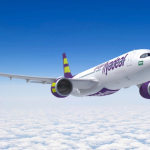



Qantas has taken a significant step forward in its ambitious Project Sunrise programme, with its first Airbus A350-1000ULR now spotted at Toulouse-Blagnac Airport. Bearing test registration F-WZNK and manufacturer serial number MSN 707, the aircraft is equipped with the powerful Rolls-Royce Trent XWB-97 engines and is expected to be delivered by the end of 2026.
This aircraft will form the backbone of Project Sunrise, enabling non-stop flights from Sydney Kingsford Smith Airport to global destinations such as London Heathrow Airport and John F. Kennedy International Airport, routes that have long been considered the “final frontier” of commercial aviation.
Pushing the limits of ultra-long-haul connectivity
First announced in 2017, Project Sunrise reflects Qantas’ long-term strategy to eliminate stopovers on some of the world’s longest routes. The airline formalised its commitment in 2022 with an order for up to 12 A350-1000ULR aircraft. These aircraft will replace current one-stop services such as the Sydney–New York route via Auckland Airport with seamless, non-stop operations.
Also Read – Air India selects Panasonic Avionics for 74-aircraft IFE MRO
With an anticipated range approaching 10,000 nautical miles and flight durations of up to 22 hours, the A350-1000ULR is set to redefine global connectivity. The aircraft cruises at approximately Mach 0.85 and will enable Sydney–London journeys in around 20–22 hours, fundamentally reshaping long-haul travel economics and passenger expectations.
Cabin innovation designing for 20+ hour flights
Recognising that ultra-long-haul travel demands a paradigm shift in onboard experience, Qantas has prioritised passenger wellbeing and comfort in its cabin design. Collaborating with Caon Design Office, renowned chef Neil Perry, and the Charles Perkins Centre, the airline has developed a next-generation interior concept tailored specifically for extended flight durations.
A standout feature is the dedicated Wellbeing Zone, a purpose-built space allowing passengers to stretch, move, and engage in light physical activity during the flight. This is complemented by curated snack options and hydration-focused offerings, addressing the physiological challenges of long-haul travel.
The cabin will also feature advanced ergonomic seating across all classes, enhanced personal space, and high-speed Wi-Fi connectivity, alongside Bluetooth-enabled in-flight entertainment systems.
Lighting, space, and the science of jet lag
A critical component of the A350-1000ULR cabin is its intelligent lighting system, offering 12 dynamic lighting scenarios such as “Sunrise,” “Sunset,” and “Awake.” These lighting sequences are scientifically calibrated to align with passengers’ circadian rhythms, helping to mitigate jet lag and improve overall in-flight well-being.
Notably, over 40% of the aircraft’s 238-seat capacity is allocated to premium cabins, including six First Class suites, 52 Business Class seats, and 40 Premium Economy seats. This premium-heavy configuration underscores Qantas’ strategy to attract high-yield passengers willing to pay for comfort on ultra-long-haul routes.
Fleet Strategy
The A350-1000ULR will play a central role in Qantas’ broader fleet modernisation and network expansion strategy. While London and New York are the initial focus, additional ultra-long-haul routes are expected as more aircraft join the fleet.
Alongside its widebody expansion, Qantas is also integrating next-generation narrowbody aircraft such as the Airbus A321XLR, further enhancing its domestic and regional connectivity.
As MSN 707 progresses through ground and flight testing over the coming months, the aviation industry will be closely watching. With Project Sunrise, Qantas is not just extending range; it is redefining the very experience of long-haul travel, placing passenger wellbeing at the centre of aircraft interior innovation.