


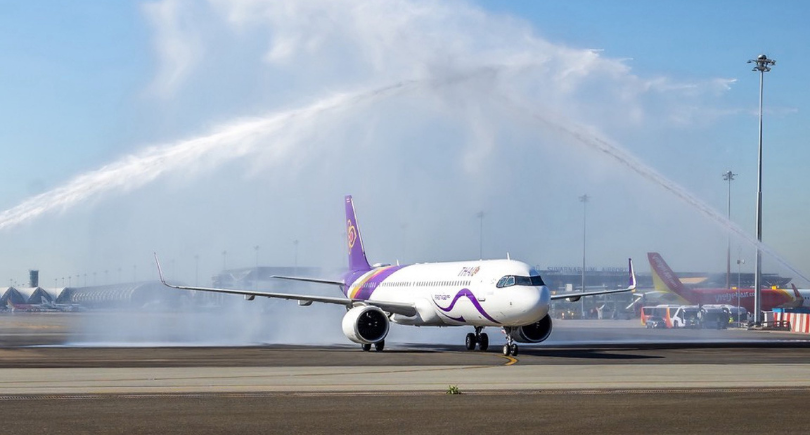
Thai Airways International has taken delivery of its first Airbus A321neo equipped with a fully lie-flat business class cabin, marking a notable shift in the carrier’s narrowbody interiors strategy and signalling a move toward product consistency across its short- and medium-haul fleet. The aircraft, registered HS-TOA, is the first of 32 A321neos the airline has on order under lease agreements signed in early 2024.
While the A321neo induction supports fleet simplification goals, the more consequential development lies in the cabin specification, which brings widebody-style premium seating and modern connectivity to routes traditionally operated with less differentiated narrowbody products.
Lie-flat business class anchors the new cabin concept
At the centre of the A321neo cabin is a 16-seat business class fitted with Thompson Aero Seating’s Vantage platform. The staggered layout alternates between 1-1 and 2-2 configurations, delivering direct aisle access for select seats and fully flat beds across five rows.
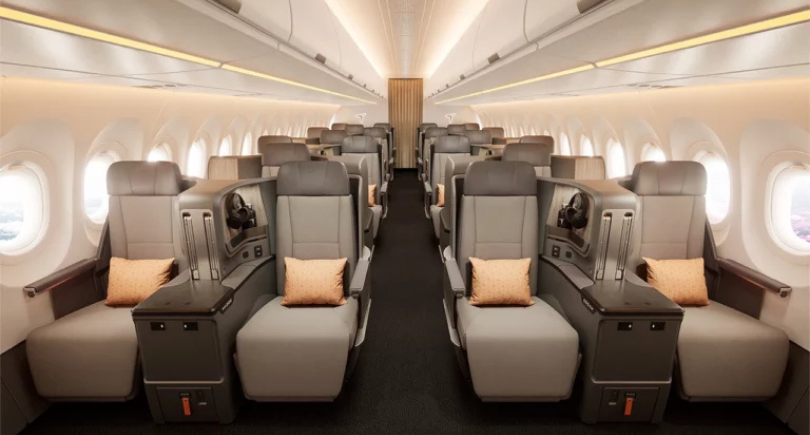
The selection of the Vantage platform reflects Thai Airways’ intent to deploy a proven, certifiable narrowbody lie-flat solution that balances passenger comfort with cabin density and weight considerations. Similar installations are already in service on A321-family aircraft at several international carriers, easing entry-into-service risk and long-term supportability.
Also Read- Korean Air Group to roll out Starlink high-speed in-flight Wi-Fi across entire fleet
For Thai Airways, the product positions the A321neo as a viable aircraft for premium-heavy regional markets and longer sectors where business class expectations increasingly mirror those of long-haul operations.
Economy cabin upgrades and connectivity
Beyond the premium cabin, the A321neo introduces a refreshed 159-seat economy class in a standard 3-3 layout, featuring seatback inflight entertainment, in-seat power, and USB charging at all positions. The aircraft is also equipped with full-cabin connectivity, with Wi-Fi available for purchase.
These features represent a step change from legacy narrowbody interiors previously operated under the Thai Smile brand, reinforcing Thai Airways’ decision to elevate mainline standards across all aircraft types.
Interiors standardisation following Thai Smile integration
The A321neo programme follows the 2024 integration of Thai Smile, whose A320 fleet was absorbed into Thai Airways’ mainline operation. While those aircraft underwent selective cabin upgrades, the A321neos are the first narrowbodies configured from delivery with a cabin concept designed specifically for Thai Airways’ long-term product roadmap.
From an interiors and MRO perspective, the move toward a standardised narrowbody cabin simplifies line maintenance, spares provisioning, and component support, while also reducing variability across seating, IFEC, and connectivity systems.
Entry into service and operational deployment
Thai Airways plans to introduce the A321neo into revenue service from January 2026, initially deploying the type on routes such as Bangkok–Singapore, Bangkok–Hong Kong, and Bangkok–Phuket. These markets are characterised by high frequency, strong premium demand, and intense regional competition, making cabin differentiation a key commercial lever.
Over time, the airline expects the A321neo to operate a significant portion of its regional network, effectively redefining the baseline passenger experience on narrowbody aircraft within the fleet.
Industry implications
The A321neo cabin configuration reflects a broader Asia-Pacific trend toward premium-configured narrowbodies, driven by yield optimisation, passenger expectations, and network flexibility. For cabin suppliers and MRO providers, the programme supports sustained demand for narrowbody lie-flat seating, IFEC systems, and connectivity solutions, alongside associated certification and lifecycle support services.
For Thai Airways, the aircraft represents more than a fleet addition. It marks a deliberate pivot toward cabin-led competitiveness, aligning narrowbody interiors more closely with long-haul standards and reinforcing the airline’s post-restructuring focus on consistency, efficiency, and product credibility in the regional market.