


As airlines sharpen their focus on ancillary revenue growth, operational efficiency, and sustainability, the aircraft cabin is fast emerging as a critical digital touchpoint. From onboard retail and payments to connectivity and passenger engagement, unified digital ecosystems are becoming essential to delivering consistent, data-led in-flight experiences.
In this exclusive interview with Aircraft Interiors Today, Fernando Guinea, President of Immfly, shares how the company’s evolving onboard platform, strengthened by its acquisition of Data Clarity, is helping airlines move beyond fragmented systems toward real-time, actionable insight. He discusses improving retail performance in low-connectivity environments, tailoring digital solutions to different airline business models, reducing waste through smarter inventory planning, and the growing role of AI and predictive analytics in shaping next-generation in-flight services for both passengers and crew.
Q. Immfly’s acquisition of Data Clarity marks a major shift toward a unified, data-driven retail and connectivity ecosystem. How is this new platform reshaping airlines’ ability to interpret passenger behaviour and retail demand, and what measurable benefits have you seen so far in early deployments?
A. Historically, retail, payments, connectivity and service data have lived in separate systems, making it difficult to identify patterns or act on them. With the acquisition of Data Clarity, we’re now bringing these streams together by analysing data generated across Immfly’s onboard digital services, with connectivity enabling faster access to that information when available.
This gives airlines clearer insight into what passengers browse, buy, and skip — and under what conditions — allowing them to forecast demand more accurately and adjust onboard inventory based on route or aircraft type. The result is less waste, better product availability and more informed pricing decisions.
These benefits are highly practical. Airlines can make timely decisions with confidence, based on what is really happening in the cabin at any given moment, rather than analysing isolated performance data days or weeks later.
Q. With digital retail and connectivity increasingly critical to ancillary revenue growth, what key operational or commercial challenges do airlines typically face before deploying Immfly’s unified platform, and how does Immfly overcome them?
A. Most airlines start with highly fragmented onboard systems. Retail, payments, connectivity, and crew tools are often sourced separately, creating operational complexity and making change difficult. Short service windows, particularly on narrowbody fleets, and limited connectivity add to that challenge.
Immfly helps airlines bridge that gap by working within those realities rather than requiring them to rebuild from scratch. Our platform is modular, allowing airlines to start with core capabilities such as payments or wireless IFE and expand over time. Offline functionality is built in by default, and integrations are designed to fit into existing cabin operations and crew workflows.
This approach reduces deployment risk and allows airlines to modernise onboard retail and services incrementally, enabling ancillary growth without wholesale disruption. Just as importantly, it recognises that progress in modern retailing is often as much about organisational readiness as technology, giving airlines and decision-makers time to adjust internal processes and operating models as the onboard environment becomes more connected.
Q. Immfly’s partnerships with carriers like Flair Airlines and TUI involve different market strategies from retail acceleration in North America to digital transformation across Europe. How does Immfly tailor its technology and commercial approach to different airline business models?
A. The underlying technology powering Immfly’s digital onboard solutions is built on a flexible core that can be configured to support different strategies. Connectivity enhances what airlines can do with the platform — enabling richer passenger engagement, real-time access to data, and more detailed reporting — but it isn’t a prerequisite. This flexibility allows us to adapt the solution to each airline’s ecosystem rather than imposing a standard rollout.
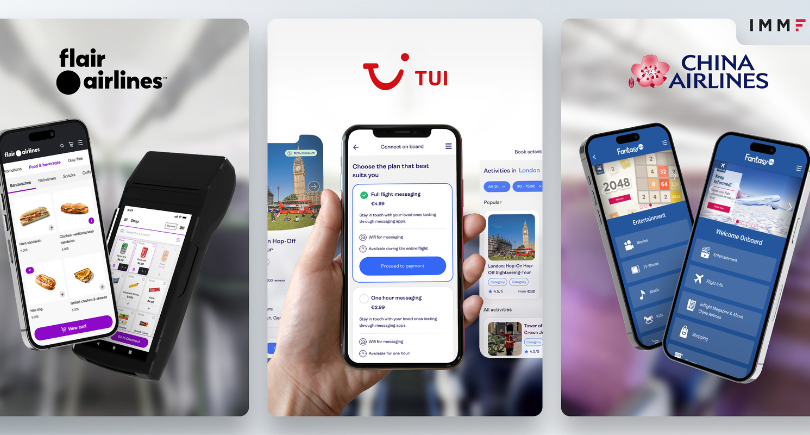
In North America, for example, we have partnered with Flair Airlines to equip its Boeing 737s with Immfly’s onboard retail technology. By combining a crew app, back-office system, and wireless in-seat ordering that passengers can use to purchase food, drinks, and retail items directly from their personal devices, the airline has recovered over 80% of previously declined payments by reducing failed and abandoned transactions during onboard service. It has also expanded ancillary revenue opportunities by making it easier for passengers to browse, order, and complete purchases without waiting for crew interaction.
In Europe, by contrast, TUI Airlines’ deployment shows how the platform can support a broader passenger engagement strategy. An onboard server delivers entertainment, messaging, and destination booking services to passengers’ own devices, and connectivity enhances the experience with real-time updates and richer digital content. This gives the airline a practical way to expand digital offers without costly or invasive changes to the aircraft.
Q. Onboard payments are a crucial revenue enabler, especially in low-connectivity environments. Can you share insights from Immfly’s collaboration with Adyen on improved payment reliability and passenger conversion, and what future payment innovations you’re most excited about?
A. The partnership with Adyen, which provides the behind-the-scenes payment infrastructure, enables onboard payments to be faster, safer, and more reliable regardless of an aircraft’s connectivity.
In practical terms, that means payments work just as well offline as online. Checkout times have dropped by several seconds, with tap-to-pay delivering 5–10% faster transactions, particularly for multi-item purchases. On narrowbody aircraft, those gains translate directly into less time spent in the aisle and smoother onboard service.
There have also been measurable improvements in fraud prevention. AI-backed payment processing has reduced fraudulent card attempts by about 4%, protecting airline revenue by lowering chargebacks and operational costs.
Looking ahead, as cabins become more connected, airlines will be able to support a broader range of payment types and higher-value transactions, while maintaining the ability to complete payments even when connectivity drops.
Q. With the ongoing expansion of wireless-IFE and connectivity solutions for e.g., extended deployments with China Airlines, how do you see the role of connectivity evolving in the overall passenger experience and aircraft digital ecosystem?
A. Travellers increasingly expect the in-flight experience to feel like a natural extension of what they can do on the ground, whether that is accessing streaming content, making purchases, or interacting with services throughout the journey.
As cabins become connected, they turn into data-rich environments that help airlines better understand how passengers engage with content and services during the flight. That insight enables tailoring the onboard experience — from IFE content to retail offers — to drive higher engagement and stronger ancillary performance. At the same time, it gives crews and operations teams better visibility into what is happening in the cabin, supporting more informed decisions around service, inventory, and planning.
Connectivity also links onboard activity with systems on the ground. This allows airlines to carry passenger interactions across the journey rather than treating each flight as an isolated moment, and to act on onboard activity more quickly once the aircraft lands.
Q. Sustainability is a major theme in aircraft interiors and onboard services today. How does Immfly’s technology, both in terms of digital retail and connectivity, contribute to airlines’ sustainability targets like for e.g., reducing paper, plastic, and waste?
A. At a basic level, Immfly helps airlines digitise processes that were historically paper- and plastic-heavy. Digital menus, receipts, and wireless IFE reduce the need for printed materials, shifting onboard interactions to passengers’ own devices.
Beyond that, Immfly’s connected retail solutions help airlines better match what they load onboard with what passengers actually buy. More accurate forecasting leads to fewer unsold items, less waste, and less unnecessary weight carried on the aircraft — supporting fuel efficiency and reducing operating costs.
In practice, sustainability benefits emerge from running a more efficient operation. When airlines have better data and clearer visibility into onboard activity, they can plan more precisely, waste less, and operate more responsibly — without treating sustainability as a separate or standalone initiative.
Q. Data intelligence is now central to hyper-personalised passenger engagement. What are the biggest hurdles in turning passenger data into actionable retail or service strategies and how does Immfly’s integrated ecosystem accelerate this process?
A.The biggest challenge isn’t collecting passenger data — it’s turning it into something airlines can act on in the cabin. Data often sits across disconnected systems, arrives too late to be useful, or lacks the operational context needed to inform decisions during a flight.
Immfly addresses this by bringing data closer to where in-flight decisions are made onboard. Retail activity, payment behaviour, and service information are captured through the same onboard tools that crews and passengers interact with, making it easier to understand what is happening in the moment rather than analysing it after the fact.
This helps airlines focus on relevance rather than broad personalisation. Offers, content, and service decisions can be better aligned with passenger behaviour and flight context, while also supporting operational needs such as inventory planning, fraud reduction, and service execution. The result is data that informs action, not just reporting.
Q. Modularity and scalability are core to Immfly’s platform especially for multi-fleet or multi-region carriers. How do you ensure seamless upgrades and technology adoption without disrupting airline operations or passenger experience?
A. It comes back to Immfly’s modular approach. Airlines can introduce new capabilities gradually rather than all at once, scaling at a pace that fits their operation. For low-cost and ultra-low-cost carriers in particular, where turnaround time is tight and aircraft availability is critical, that flexibility is essential.
Even connectivity is designed with those constraints in mind. Immfly’s high-speed, low-latency connectivity solutions can typically be installed in under 30 hours, helping airlines add capability without extended aircraft downtime or major schedule disruption.
The platform is built to coexist with existing airline infrastructure, reducing the need for wholesale operational change. Crew workflows remain familiar, training requirements are minimal, and passenger-facing experiences are introduced through interfaces they already understand, such as personal devices and user-friendly onboard portals.
This approach allows airlines to scale across fleets and regions while maintaining consistency in the onboard experience, without disrupting day-to-day operations or adding unnecessary complexity.
Q. Looking ahead, as artificial intelligence and predictive analytics evolve, how do you envision Immfly’s role in shaping next-generation in-flight services for both passengers and crew over the next 3–5 years?
A. We see AI as a practical tool that helps airlines better utilise their data to make small improvements that can have a meaningful operational and commercial impact.
Take demand forecasting, for instance. AI can help identify patterns in what passengers browse and buy across routes, aircraft types, and service windows, allowing airlines to load more accurately and reduce waste. In payments and fraud prevention, AI helps distinguish between genuine transactions and risky behaviour, reducing false declines while limiting exposure to chargebacks and operational costs. The focus is not automation for its own sake but improving reliability and decision-making in a challenging onboard environment.
Over the next three to five years, passengers are likely to notice more personalised offers through digital retail platforms, smoother transactions, and better continuity between ground and air. For crew, the impact is less visible but just as important. Crew tools can help highlight what needs attention during service, reduce failed transactions, and minimise manual checks or post-flight reconciliation.
Immfly’s role is to bring these capabilities into the cabin in a way that fits real airline operations.
By combining onboard data capture, modular digital retail tools, and connectivity‑enabled intelligence, Immfly acts as the bridge between AI insights and day‑to‑day decision‑making. Our platform ensures that airlines can apply predictive analytics where they matter most — during service, in the aisle, and across the onboard journey — without adding complexity for crew or requiring major changes to existing systems.
The goal is not to introduce more technology into the cabin, but to remove friction from everyday operations and make the in-flight experience feel more straightforward and more consistent for everyone involved.