


For an industry often focused on seat counts, connectivity upgrades and operational efficiency, sometimes aviation reminds passengers that flying can still feel magical.
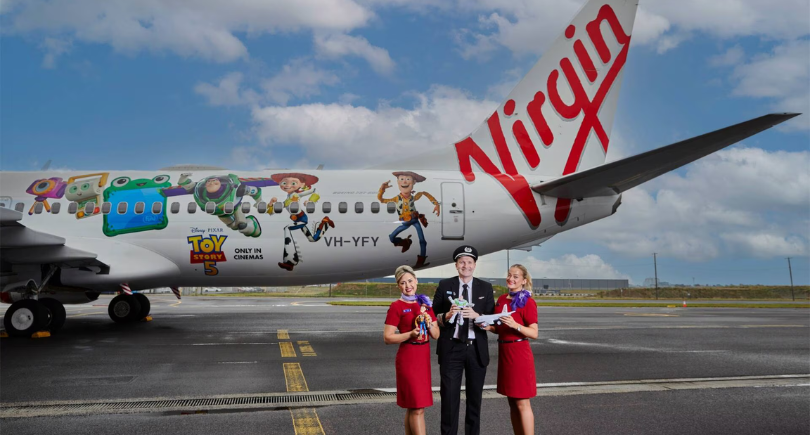
This week, Virgin Australia did exactly that with the unveiling of its new Disney and Pixar-inspired Toy Story 5 themed Boeing 737-800, the airline’s first co-branded aircraft livery in almost a decade. But this is far more than a colourful aircraft paint scheme.
It is a carefully crafted passenger experience story one, that blends nostalgia, entertainment, emotional connection and cabin engagement into a fully immersive journey designed for families, children and even adults who grew up with Woody, Buzz Lightyear and Jessie.
Also Read – Lufthansa to introduce Allegris premium cabin on Singapore–Munich Route
Ahead of the global release of Toy Story 5 in June 2026, Virgin Australia has transformed one of its narrowbody aircraft into a flying celebration of one of the world’s most beloved film franchises. The aircraft features iconic Toy Story characters across its exterior, instantly turning heads on the tarmac and across social media.
Yet the real story lies beyond the livery.
Turning passenger journey into an experience
Modern aircraft interiors are evolving rapidly. Airlines are no longer thinking only about seats, lighting or inflight entertainment screens. Increasingly, they are designing emotional experiences. Virgin Australia’s Toy Story initiative is a strong example of how airlines are now extending storytelling beyond the cabin and across the entire customer journey.
From June 2026, passengers onboard Virgin Australia domestic flights will receive Toy Story-themed surprises including children’s colouring packs, dedicated inflight entertainment content and even an interactive onboard game linked to a family travel competition.
The airline is also introducing “Toy Tickets”, personalised boarding passes for children’s teddy bears and cuddly toys in what is believed to be an Australian airline first.
It may sound simple, but initiatives like this matter. They create moments families remember long after the flight is over. And in today’s competitive airline market, emotional connection is becoming just as important as operational performance.
Why airlines are investing in feel-good experiences
Post-pandemic travel has changed passenger expectations significantly.
Travellers increasingly want experiences that feel personal, comforting and memorable — especially families travelling with children. Airlines understand this shift and are investing heavily in customer experience differentiation.
For the aircraft interiors industry, this represents a growing opportunity.
Cabins are no longer just transport spaces. They are becoming branded environments capable of creating emotional engagement, strengthening loyalty programmes and enhancing passenger satisfaction.
Virgin Australia’s campaign cleverly integrates multiple touchpoints like exterior aircraft branding, cabin entertainment, family focussed passenger engagement, airport experiences, lounge activities and loyalty programs
The result is a seamless brand experience extending from check-in to arrival.
Nostalgia as a powerful aviation tool
One of the reasons the campaign feels so effective is because Toy Story itself carries emotional weight across generations. More than 30 years after audiences first met Woody and Buzz Lightyear, the franchise continues to resonate with both children and adults. Many parents travelling today grew up watching the original films themselves.
Virgin Australia appears to understand that perfectly.
The airline is not simply marketing to children; it is marketing to shared family nostalgia. That emotional storytelling becomes particularly powerful in aviation, where travel itself is often linked to family memories, holidays and milestones.
A new era of cabin branding
Co-branded aircraft are not new, but airlines today are approaching them differently. Rather than serving purely as promotional advertising, themed aircraft are increasingly becoming extensions of the passenger experience itself.
This reflects a wider shift in aviation interiors toward experiential design. Passengers now expect cabins to deliver better entertainment, emotional connect, family engagement and social media worthy experiences. Themed collaborations like this also generate enormous visibility online, extending airline branding far beyond airports and onboard cabins.
For Virgin Australia, the Toy Story 5 partnership successfully combines customer engagement, family-friendly branding and experiential travel into one cohesive campaign.
Recent years have seen airlines globally navigating operational disruptions, rising costs, staffing shortages and increasing passenger stress. Amid all of that, the simple joy of flying has sometimes been lost.
Virgin Australia’s Toy Story aircraft feels like a reminder that aviation can still create excitement and wonder.
Whether it is a child receiving a boarding pass for their teddy bear, families spotting Buzz Lightyear at the gate, or adults smiling at a character they grew up with, the campaign taps into something the industry sometimes overlooks, emotional memory.
Because for a few moments, an aircraft stops feeling like just another flight and starts feeling like part of the adventure itself.