



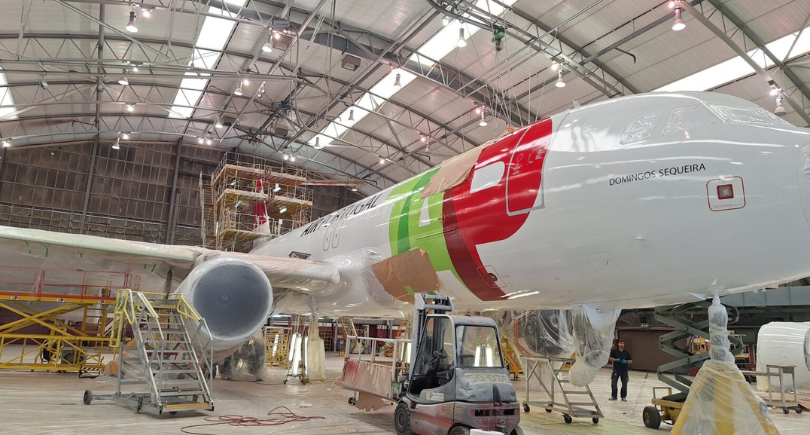
TAP Air Portugal has completed operational trials of a lightweight aircraft coating technology developed by AkzoNobel Aerospace Coatings, paving the way for a fleet-wide rollout aimed at improving fuel efficiency, reducing operating costs and lowering carbon emissions.
The trials, conducted using AkzoNobel’s Aerobase UPD basecoat system, demonstrated that the advanced coating can reduce aircraft paint weight by up to 26 kg per aircraft while maintaining the durability, appearance and finish quality required for commercial airline operations.
Testing on a TAP Air Portugal Airbus A320 achieved a weight reduction of 24 kg, prompting the airline to recoat a second A320 and begin planning for broader implementation across its fleet.
According to AkzoNobel Aerospace Coatings, the lighter coating technology is expected to generate significant long-term operational benefits. Once deployed across the airline’s fleet, the solution could help TAP Air Portugal save approximately 428.5 tonnes of fuel annually, reduce carbon dioxide emissions by around 1,353 tonnes each year, and deliver annual cost savings exceeding €500,000.
The Aerobase UPD formulation reduces total basecoat film thickness by 36% compared with conventional two-coat application systems. By achieving the required colour coverage and finish quality in a single application cycle, the technology eliminates the need for a second basecoat layer, reducing both aircraft weight and paint shop processing time.
In addition to supporting airline sustainability goals, the coating system improves maintenance productivity by simplifying the painting process and increasing application consistency. The enhanced formulation also offers approximately 40% greater sag resistance, helping maintenance teams achieve more uniform finishes under varying paint shop conditions.
“At TAP Air Portugal, we continuously evaluate opportunities to improve operational efficiency and reduce environmental impact across our operations,” said João Carvalho, Structures Engineer, TAP Air Portugal. “The results achieved through this collaboration with AkzoNobel Aerospace Coatings demonstrate how relatively small weight reductions, when applied consistently across aircraft fleets, can contribute to meaningful long-term fuel and emissions savings while supporting operational efficiency.”
Aurore Bournazel, Segment Manager – OEM, MRO & Airlines, AkzoNobel Aerospace Coatings, said the programme highlights the role advanced coatings can play in improving airline sustainability.
“This programme with TAP Air Portugal demonstrates how incremental innovations in coating technology can deliver measurable operational benefits and emissions savings for airlines,” she said. “By reducing total film build and simplifying the application process, Aerobase UPD helps operators lower aircraft weight, improve paint shop productivity and maintain the high-quality finish standards required across commercial aviation fleets.”
Certified to AMS3095 standards, Aerobase UPD is compatible with mixed-fleet MRO operations and integrates with existing Aerobase paint systems, allowing airlines and maintenance providers to adopt the technology without major changes to current paint shop processes.
As airlines continue to explore every opportunity to improve fuel efficiency and reduce environmental impact, innovations such as lightweight coating systems are emerging as practical solutions that deliver measurable operational, economic and sustainability benefits throughout an aircraft’s service life.