


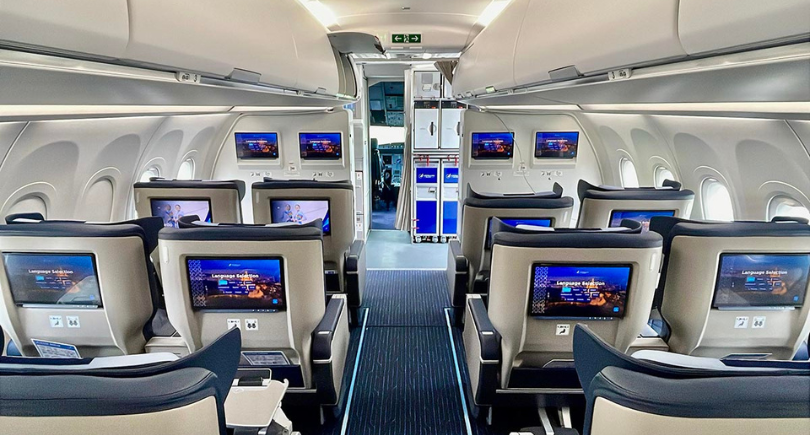
Azerbaijan Airlines has marked a milestone in its cabin modernization strategy with the entry into commercial service of Panasonic Avionics’ next-generation Astrova inflight entertainment (IFE) solution and Modular Interactive (MI) platform onboard its Airbus A320neo family aircraft.
The rollout represents a major enhancement to the carrier’s onboard passenger experience and forms part of a broader fleet transformation programme aimed at delivering more personalized, connected and immersive journeys for travelers across its network.
The deployment covers 11 Airbus narrowbody aircraft, including six A321neo and five A320neo aircraft, through a combination of linefit and retrofit installations. In total, Panasonic Avionics’ Astrova and MI solutions are expected to be introduced across 22 aircraft in the Azerbaijan Airlines fleet.
Also Read – Saudia’s A321XLR featuring premium heavy cabin and new business class suites
Passengers travelling on the newly equipped aircraft will experience Panasonic Avionics’ latest-generation inflight entertainment system, featuring 4K OLED HDR10+ seatback displays designed to deliver enhanced picture quality, richer colours and greater viewing clarity. The system is complemented by Panasonic’s latest Bluetooth audio technology, enabling passengers to seamlessly connect their personal wireless headphones and enjoy a more convenient entertainment experience.
The aircraft are also equipped with up to 67W USB-C charging capability at every seat, allowing passengers to fast-charge smartphones, tablets, laptops and other personal electronic devices throughout the flight.
Beyond hardware upgrades, Azerbaijan Airlines is leveraging Panasonic Avionics’ Modular Interactive platform to create a more dynamic and personalized passenger experience. At the heart of the solution is MI Studio, a cloud-based interactive content management platform that enables airlines to rapidly customize and update onboard digital experiences.
The platform allows the airline to introduce seasonal campaigns, destination-specific content, loyalty programme integrations and branded passenger experiences while reducing development timelines. The flexible architecture also enables personalization based on factors such as cabin class, route, destination and customer profile, helping deliver a more tailored inflight experience.
According to Panasonic Avionics, the MI platform provides airlines with greater autonomy in managing their digital passenger engagement strategies by allowing them to configure layouts, themes, applications and branded content through a centralized interface.
Hernan Abbes, Senior Vice President of Global Sales at Panasonic Avionics, described the entry into service as an important milestone for both companies, noting that Astrova’s modular architecture and the MI platform provide airlines with the flexibility and scalability required to adapt to evolving passenger expectations and emerging technologies.
Aziz Koseni, Head of Sales for Europe, the Middle East and Africa at Panasonic Avionics, said the deployment reflects Azerbaijan Airlines’ commitment to enhancing passenger comfort, personalization and onboard engagement while reinforcing the growing momentum behind the adoption of Astrova and MI across the airline industry.
Jonathan DeOliveira, Director of the Customer Experience Department at Azerbaijan Airlines, said the introduction of Astrova forms part of the airline’s broader strategy to modernize its fleet and elevate customer experience through innovation. He noted that the new system strengthens onboard comfort, connectivity and digital engagement while supporting the airline’s vision for smarter and more connected air travel.
One of Astrova’s key differentiators is its future-ready architecture, which enables airlines to introduce upgrades and enhancements as passenger technology expectations evolve. Panasonic Avionics says the system can accommodate future developments in connectivity, Bluetooth functionality, power delivery and passenger engagement applications without requiring major hardware changes.
The platform also supports advanced testing and optimization capabilities, allowing airlines to conduct A/B testing and continuously refine the passenger interface and digital experience based on customer preferences and usage patterns.
As airlines increasingly focus on personalization and digital engagement as differentiators, the introduction of Astrova and MI positions Azerbaijan Airlines among a growing group of carriers investing in next-generation cabin technologies designed to deliver more connected, responsive and passenger-centric travel experiences