


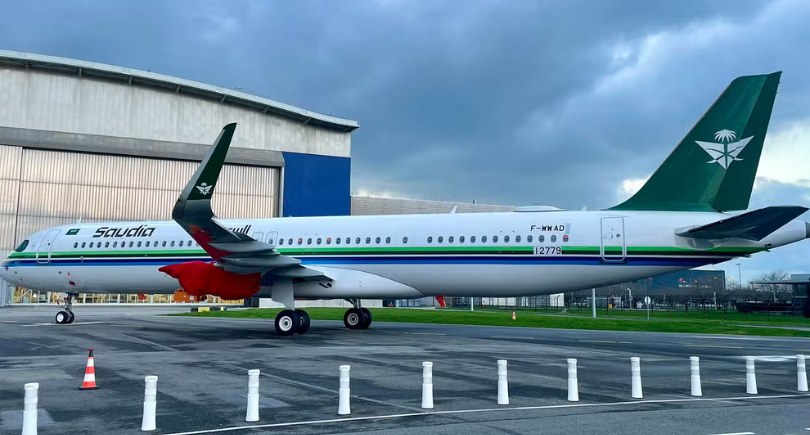
Saudia has officially taken delivery of its first Airbus A321XLR, becoming the launch operator of the extra-long-range narrowbody aircraft in the Middle East and introducing one of the most premium-focused cabin configurations currently flying on the A321XLR platform.
The aircraft, registered HZ-ASBA, was handed over at Airbus’ Toulouse facility on May 24 and is expected to enter commercial service in early June, initially operating between Jeddah and Madrid before expanding onto additional international routes across Europe, Africa and South Asia.
While the Airbus A321XLR has been positioned globally as a game-changing long-range narrowbody aircraft, Saudia’s configuration places a particularly strong emphasis on passenger comfort, premium seating density and long-haul cabin experience.
Also Read – Boeing advances Gilat Sidewinder Line-Fit IFC solution
Premium-heavy cabin strategy
Saudia has configured the aircraft with just 144 seats, significantly fewer than many traditional narrowbody layouts allowing the airline to create a spacious and premium-oriented onboard environment. The cabin includes 24 Business Class suites and 120 Economy Class seats
The configuration currently represents one of the most premium-heavy A321XLR cabin layouts in service globally. By comparison, several competing operators have opted for denser configurations with fewer premium seats.
The reduced passenger density is expected to enhance overall cabin spaciousness, improve passenger circulation and provide a quieter onboard experience, particularly on long-duration flights of up to 11 hours.
New Thompson VantageSOLO business class suites
A major highlight of Saudia’s new A321XLR interior is the introduction of its latest Business Class suite product based on the Thompson Aero Seating VantageSOLO platform.
The suites are arranged in a highly passenger-centric 1-1 configuration, ensuring direct aisle access for every Business Class passenger, a feature increasingly becoming standard on premium long-haul narrowbody aircraft.
The VantageSOLO seat transforms into a fully flat bed and has been designed specifically for long-range narrowbody operations where airlines aim to replicate widebody-style premium experiences within a single-aisle cabin environment.
The product also offers enhanced privacy, increased personal storage, larger entertainment viewing areas, improved sleeping comfort for overnight sectors and direct aisle access without passenger disturbance.
The same seating platform has already gained recognition through deployment on JetBlue’s Mint cabins and Iberia’s A321XLR fleet, but Saudia’s 24-suite configuration gives it one of the largest lie-flat Business Class capacities among all A321XLR operators to date.
Industry observers note that Saudia’s premium cabin density even surpasses configurations planned by several major international carriers, including American Airlines and Aer Lingus.
Economy Cabin Designed Around Space Efficiency
The Economy Class cabin accommodates 120 passengers and is currently among the lowest-density economy layouts on the A321XLR platform.
Although Saudia has not yet released detailed seat specifications publicly, the lower overall passenger count is expected to contribute to improved legroom perception, faster boarding and deplaning, reduced congestion in galley and lavatory areas and enhanced passenger comfort on long-haul narrowbody missions.
The cabin strategy reflects a broader airline industry shift toward using premium-configured narrowbody aircraft on “long and thin” international routes where passenger demand may not justify widebody deployment year-round.
Long-haul narrowbody comfort evolution
The arrival of the A321XLR marks another step in the evolution of long-range narrowbody travel, with airlines increasingly focusing on delivering widebody-level comfort on smaller aircraft.
With a range of up to 4,700 nautical miles, the A321XLR enables carriers like Saudia to operate nonstop services to secondary international destinations while maintaining lower operating costs and greater scheduling flexibility compared to larger twin-aisle aircraft.
For passengers, this trend is also reshaping expectations around narrowbody travel, particularly in premium cabins where airlines are investing heavily in:
- Lie-flat seating
- Direct aisle access
- Enhanced privacy
- Improved cabin aesthetics
- Higher-end inflight experiences
Saudia plans to deploy the aircraft on routes connecting Saudi Arabia with destinations including Madrid, Paris, Vienna, Milan, Rome, Brussels, Barcelona, Dakar and the Maldives.
The A321XLR delivery forms part of Saudia’s broader narrowbody fleet modernisation strategy. The airline already operates Airbus A320-family aircraft, including the A320ceo, A321ceo and A321neo, and continues to expand its commitment to the A320neo family as it modernises regional and medium-haul operations.
Saudia is expected to receive all 15 of its ordered A321XLR aircraft by the end of 2027, with deliveries anticipated at a rate of approximately one aircraft per month over the coming phases of the programme.
As airlines increasingly prioritise premium cabin differentiation and passenger comfort on long-haul narrowbody sectors, Saudia’s A321XLR configuration could emerge as one of the benchmark cabin products in this rapidly growing segment of the market.