


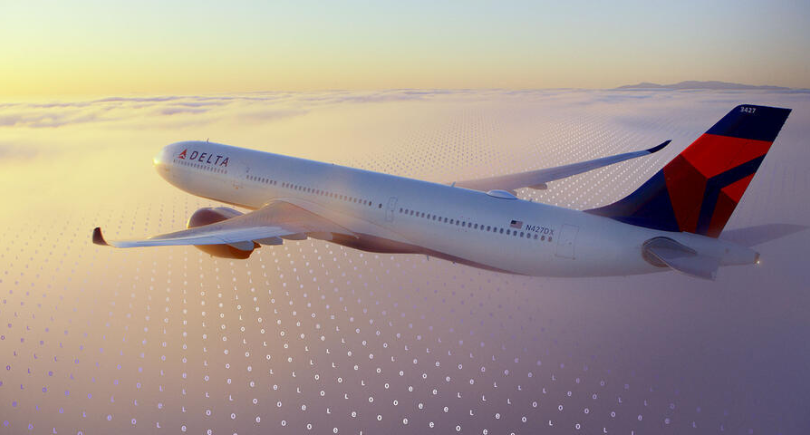
In a move that signals a long-term shift in how airlines approach in-flight connectivity (IFC), Delta Air Lines has selected Project Kuiper, Amazon’s low-Earth orbit (LEO) satellite system, over Starlink to equip a significant portion of its fleet. The decision, which will see approximately 500 aircraft fitted with the system starting 2028, reflects a broader strategic prioritisation of ecosystem integration, scalability, and cost efficiency over immediate performance advantages.
At the heart of this decision is a calculated trade-off. While Starlink has already demonstrated superior in-flight connectivity performance with high speeds and low latency and is being rapidly adopted by carriers such as United Airlines, Alaska Airlines, and Southwest Airlines, Delta is aligning itself with a platform that is still under development. Amazon’s LEO network, part of Project Kuiper, is expected to become operational around 2027, with Delta planning phased deployment from 2028 onward.
From an aircraft interiors and passenger experience perspective, this decision underscores a critical evolution in IFC thinking. Connectivity is no longer viewed as a standalone feature but as an integrated digital layer within the broader cabin ecosystem. By choosing Amazon’s platform, Delta is effectively linking its future connectivity infrastructure with Amazon Web Services (AWS), opening up possibilities for deeper data integration, personalised passenger services, and enhanced onboard digital ecosystems.
Also Read – British Airways adds Audible content to IFE
Technologically, Amazon’s LEO system promises competitive performance. Operating at altitudes between approximately 367 and 391 miles, the satellites are significantly closer to Earth than traditional geostationary systems, enabling reduced latency and improved connection stability. The network’s use of optical inter-satellite links is designed to create a mesh architecture capable of supporting high data throughput, potentially up to 1 Gbps per device under optimal conditions. For cabin environments, this could translate into seamless streaming, real-time applications, and consistent connectivity across all passenger touchpoints.
However, the system’s current developmental status introduces a layer of uncertainty. Unlike Starlink, which is already operational and being deployed across multiple airline fleets, Project Kuiper is yet to achieve full-scale commercial readiness. Delta’s willingness to commit ahead of proven deployment highlights a strategic preference for long-term capability building rather than short-term competitive parity.
Delta plans to roll out the system in phases, initially targeting around 40% of its fleet. This measured approach allows the airline to mitigate risk while aligning installation timelines with the maturity of the Kuiper network. It also reflects a broader industry trend where airlines are adopting modular and scalable IFC strategies rather than committing to fleet-wide retrofits in a single phase.
In the interim, Delta continues to rely on its existing connectivity offering, which has been delivered in partnership with T-Mobile since 2023. While the airline has made strides by offering free Wi-Fi across a large portion of its fleet, covering over 1,150 aircraft, the current system has faced criticism for inconsistent speeds and higher latency, particularly on long-haul and transpacific routes. Planned enhancements, including expanded free connectivity on international routes by 2026, may address some gaps but are unlikely to fully match the performance benchmarks set by Starlink-enabled aircraft.
The competitive landscape further intensifies the stakes. Airlines that have already adopted Starlink are positioning connectivity as a differentiator in the passenger experience, particularly for premium and long-haul travellers. Meanwhile, JetBlue Airways is also exploring Project Kuiper but has tied its commitment to the system achieving operational readiness by 2027, highlighting industry caution around deployment timelines. American Airlines, on the other hand, continues to evaluate both platforms, reflecting the broader uncertainty and strategic divergence within the sector.
For aircraft interiors stakeholders, Delta’s decision reinforces the growing importance of IFC as a foundational component of cabin design and passenger engagement. Connectivity is increasingly intertwined with inflight entertainment systems, passenger service interfaces, and airline digital ecosystems. The choice of provider, therefore, has implications far beyond bandwidth impacting everything from content delivery and e-commerce to real-time operational analytics.
Ultimately, Delta’s bet on Amazon’s LEO network represents a forward-looking strategy aimed at future-proofing its cabin experience. While it may face short-term competitive pressure from airlines already offering high-speed, low-latency connectivity, the long-term payoff could lie in a more integrated, scalable, and cost-efficient digital infrastructure.
For passengers, the immediate impact may be limited, with current connectivity offerings continuing to evolve incrementally. However, if Amazon’s Project Kuiper delivers on its promises, Delta’s approach could redefine expectations around seamless, high-performance, and fully integrated in-flight digital experiences in the years ahead.