


In a move that reflects the growing emphasis on passenger-centric cabin innovation, United Airlines has announced the introduction of its new “Relax Row” concept, an enhanced economy seating solution aimed at improving comfort on long-haul flights.
The product represents a strategic attempt to bridge the gap between standard economy and premium economy offerings, addressing one of the most persistent challenges in commercial aviation: passenger comfort in high-density cabins.
Reimagining economy seating
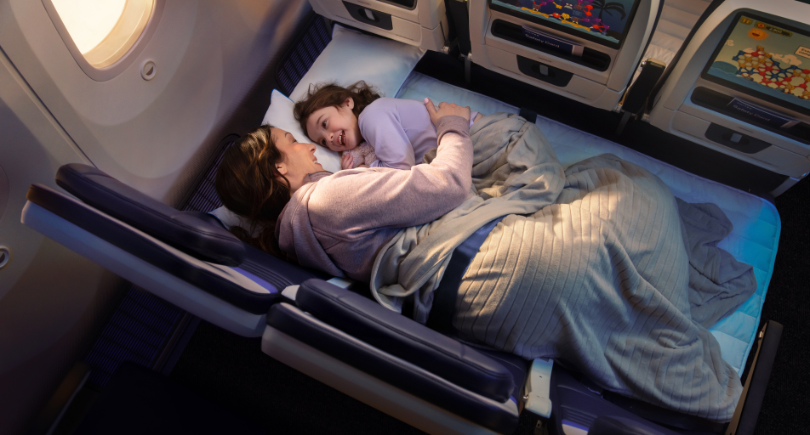
At the core of the Relax Row concept is a reconfiguration of a standard three-seat economy row. Each seat is equipped with adjustable leg rests that can be elevated to a 90-degree angle. When fully deployed across all three seats, the leg rests create a continuous, padded surface, effectively transforming the row into a couch-like space that allows passengers to stretch out or lie down.
Also Read – ST Engineering, Airbus Defence and space sign MoU for A330 MRTT+ cabin modification programme
This approach introduces a flexible seating architecture within the constraints of existing economy cabin layouts without requiring a full redesign of seat structures or a significant reduction in seat count.
The concept is particularly aligned with evolving passenger expectations for rest and sleep on long-haul sectors, where traditional upright seating continues to be a major source of discomfort.
The Relax Row is designed to cater to a broad passenger base, including families, couples, and solo travellers willing to pay a premium for additional space without upgrading to a higher cabin class.
To enhance the onboard experience, the offering includes a suite of soft products such as custom-fitted mattress pads, additional pillows, blankets, and child-friendly amenities. This layered approach, combining hard product modification with soft product enhancements, reflects a growing trend in cabin interiors where perceived comfort is as critical as physical space.
Importantly, the product is not positioned as a replacement for premium economy, but rather as an intermediate option that provides incremental comfort at a lower price point.
Fleet integration and rollout
United Airlines plans to introduce the Relax Row starting in 2027, with a phased rollout targeting more than 200 widebody aircraft, including the Boeing 787 and Boeing 777 fleets, by 2030.
Each aircraft is expected to feature up to 12 Relax Row sections, indicating that the airline is positioning the product as a scalable and integral component of its long-haul cabin offering rather than a niche or limited feature.
The seating will be installed between standard economy and the airline’s premium economy cabin (United Premium Plus), reinforcing its role as a hybrid product within the cabin hierarchy.
From an aircraft interiors perspective, the Relax Row concept highlights a broader industry shift towards modularity and adaptability in seat design. Rather than relying solely on fixed cabin segmentation, airlines are increasingly exploring flexible configurations that can deliver differentiated experiences within the same footprint.
The initiative also underscores the commercial importance of ancillary revenue streams. By monetising incremental comfort within economy class, airlines can unlock new revenue opportunities while maintaining overall seat density, a critical factor in long-haul profitability.
Furthermore, the introduction of such concepts signals intensifying competition in the mid-tier cabin segment, where airlines are seeking to attract price-sensitive passengers who still prioritise comfort on extended journeys.
A Step towards the future
As long-haul travel demand continues to grow globally, innovations like the Relax Row reflect a pragmatic evolution in cabin interiors, one that balances operational efficiency with passenger well-being.
For the industry, it raises important questions around the future of economy class design: how to optimise limited space, enhance rest, and deliver value without fundamentally altering aircraft configurations.
With its planned rollout across a significant portion of its widebody fleet, United Airlines’ Relax Row could set a precedent for other carriers and seat manufacturers exploring next-generation economy seating solutions.