



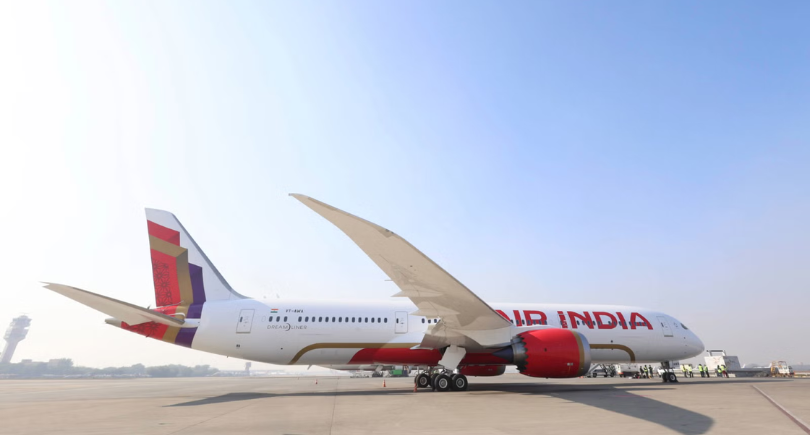
Air India has quietly crossed a defining milestone in its transformation journey, one that reshapes how Indian long-haul cabins will be designed, delivered, and experienced in the years ahead.
With the arrival of its first line-fit, factory-installed Boeing 787-9 Dreamliner at Delhi’s Indira Gandhi International Airport, Air India has moved decisively from incremental cabin upgrades to a full-scale, OEM-integrated interior modernisation strategy.
Unlike retrofit programmes that refresh aircraft after delivery, the new 787-9s are being delivered with fully bespoke Air India interiors installed directly on Boeing’s production line, a shift that elevates consistency, certification efficiency, product quality, and brand control across the airline’s widebody fleet.
Also Read – Saudia prepares premium narrowbody cabins for long-haul A321XLR operations
A structural shift in cabin strategy from line-fit to retro fit
The newly delivered aircraft, registered VT-AWA, is the first Dreamliner in Air India’s fleet to arrive with its complete interior package pre-installed at the factory. This marks a strategic transition for the airline, from reactive cabin refurbishments to proactive, design-led fleet planning.
Factory-fit cabins offer clear advantages:
• Higher manufacturing precision and finish quality
• Faster aircraft entry into service
• Reduced downtime and modification costs
• Standardised certification pathways
• Brand-consistent product rollouts
For Air India, this enables scalable cabin consistency, a critical requirement as the airline rebuilds its global network and customer perception.
The 787-9 is configured with 296 seats across Business Class, Premium Economy, and Economy, carefully structured to serve long-haul markets while balancing comfort density and yield.
Although the airline is yet to formally unveil individual seat models, Air India has confirmed that:
• All cabins feature newly designed seat architecture
• New monument and galley layouts improve service flow
• Lighting, materials and textures align with the new Air India brand language
• Cabin finish standards are harmonised across the entire 787 fleet
These interiors will become the baseline reference cabin for all Boeing 787 aircraft at Air India.
Premium Economy
One of the most strategic aspects of the new interior philosophy is the strengthening of Premium Economy as a distinct long-haul revenue cabin.
Globally, Premium Economy continues to outperform Economy and even Business on margin efficiency. Air India’s factory-fit integration ensures:
• True seat differentiation
• Enhanced pitch and recline geometry
• Dedicated cabin zones
• Improved IFE and power provisions
This positions the airline to capture higher-yield leisure and SME corporate traffic across Europe, Southeast Asia, Australia and North America.
Retrofitting the Legacy Fleet
Air India is concurrently executing one of the most comprehensive Dreamliner retrofit programmes in the region. Twenty-six Boeing 787-8 aircraft are undergoing full nose-to-tail refurbishment, bringing them to the same interior benchmark as the new 787-9.
Upgrades include:
• New seat covers and structures
• New lighting systems
• New monuments, lavatories, and galleys
• New in-flight entertainment and connectivity
• New Air India livery and branding
By the end of 2026, nearly 60% of Air India’s wide-body fleet will feature modern, harmonised cabins, dramatically improving passenger consistency and operational reliability.
What distinguishes Air India’s approach is that cabin interiors are no longer treated as cosmetic upgrades but as core brand infrastructure.
Factory-fit cabins reduce aircraft downtime, improve cabin part commonality, simplify training and maintenance, and allow faster deployment on premium long-haul routes. This directly impacts:
• Dispatch reliability
• Cabin crew productivity
• Turnaround efficiency
• Customer satisfaction
• Yield performance
In an era where passengers increasingly choose airlines based on seat comfort, cabin lighting, storage, power access and privacy, Air India’s cabin strategy is becoming a competitive weapon, not a secondary feature.
The first line-fit Boeing 787-9 is expected to enter long-haul commercial service in February 2026, with route announcements expected shortly. Five more widebody aircraft, including Airbus A350-1000s, will follow throughout the year.
As Air India rebuilds its international product proposition, the interiors of its new Dreamliners will define how the global market experiences the “new Air India”.
Air India’s line-fit 787-9 is the template of its future cabin DNA and with factory-installed interiors now becoming the norm rather than the exception, India’s national carrier is finally placing cabin design where it belongs, at the heart of airline strategy.